
In most cases the sounds we hear are not steady noises, instead the sound pressure level fluctuates over time as well as appearing to vary in tone and magnitude. To measure this fluctuating noise we use Ln values – but what are they and how are they used?
Ln values are statistical noise levels (sometimes called percentiles) used to assess noise levels (sound pressure levels) from fluctuating noise sources over time. Any statistical value between 0.01% and 99.99% may be calculated where ‘n’ is the percent exceeded noise level over a timed measurement period (T). For example, a sample of fluctuating noise levels taken once a second every second for an hour gives us 3600 samples. These samples can give us some helpful statistics: if we add all the samples together and divide by 3600 (T) then we will get the average or L50% value of the noise over the hour. And if we do the same and all the samples together that exceeded a pre-determined noise level (e.g. 65dB(A)), then divide by total time (T) then we reach the n-Percent Exceeded Level, Ln.
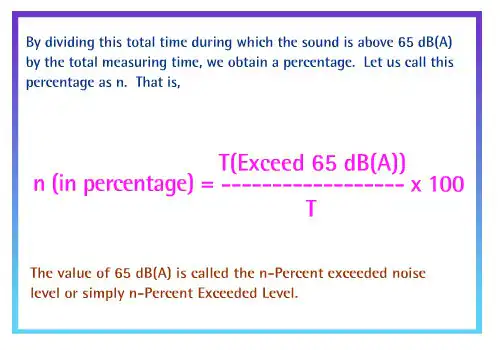
The n-percent exceeded level, Ln, is the sound pressure level exceeded for n percent of the time. In other words, for n percent of the time, the fluctuating sound pressure levels are higher than the Ln level.
The most commonly used Ln values are the L10 and the L50 or L90. Modern sound level meters like the Pulsar Nova (Model 45 & 46) do it all for you. They sample at more than ten times a second to improve the statistical accuracy if the sound levels fluctuate widely over time or are intermittent.
Ln values – L10, L50 and L90
The commonly used values of n for the n-percent exceeded level, Ln are 10, 50, and 90.
L10 is the level exceeded for 10% of the time. For 10% of the time, the sound or noise has a sound pressure level above L10. For the rest of the time, the sound or noise has a sound pressure level at or below L10. These higher sound pressure levels are probably due to sporadic or intermittent events. L10 is often used when assessing traffic noise and in planning applications: L10 is the level exceeded for 10% of the time and takes account of any annoying peaks in noise.
L50 is the level exceeded for 50% of the time. It is statistically the mid-point of the noise readings. It represents the median of the fluctuating noise levels.
L90 is the level exceeded for 90% of the time. For 90% of the time, the noise level is above this level. It is generally considered to be representing the background or ambient level of a noise environment. L90 is often used to quantify the background noise levels in assessments of noise pollution and nuisance noise from industrial sources. For example, in BS 4142 Method for ‘Rating Industrial Noise Affecting Mixed Residential and Industrial Areas’.
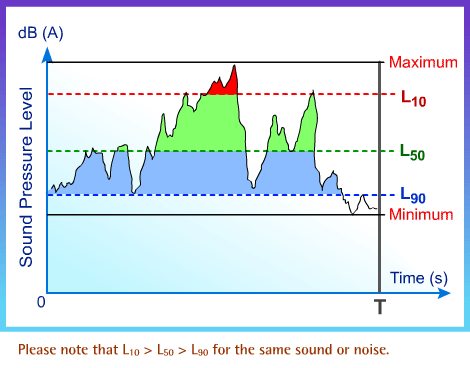
For a varying sound, L10 is greater than L50 which in turn is greater than L90.
To find out more about other noise measurement and acoustic terms please refer to our comprehensive online Acoustic Glossary. We also provide help and guidance in understanding noise measurements through our Online Noise Awareness Training Course.