PPE should always be regarded as a ‘last resort’ to protect against risks to safety and health in the workplace. The provision of personal hearing protection is no different. You may find resistance from your workforce using them and they can be costly to maintain and replace. They can also interfere with communications, more specifically with alarm systems on dangerous sites, and they can present hygiene problems.
The selection of hearing protection for noise at work is a simple process as long as you have the right equipment and are “competent” in its use.
There are three methods for predicting the overall attenuation or the effectiveness of hearing protection at your disposal. Each method is slightly different and ranges from the simplest to the most accurate form of calculation.
- As a minimum, you will need an integrating Class 2 sound level meter. For this example, we are using the Nova Noise at Work, which can ‘measure’ LAeq, LCeq (not to be confused with Peak dBC) and 1/1 Octave Bands.
- Importantly, you should only consider hearing protection that conforms to EN 352-1 and which comes with a Technical Specification that includes its ‘Performance Numbers’.
Let’s use a practical work example to highlight this.
You have carried out a number of noise measurements in a woodworking shop and need to recommend hearing protection for the various pieces of equipment. You now have a number of options as ‘recommended’ by the Health and Safety Executive with their ‘Hearing Protection Calculators’ (HPC).
So, let’s start by looking for hearing protection for the Woodworking Shop’s Planer, that have been measured respectively with an LAeq of 101.3 decibels and an LCeq of 104.7 decibels.
1. Hearing Protection Selection with the SNR Method (Single Number Rating)
If you use the SNR Method for the Planer, you need the measured LCeq plus the SNR taken from the Hearing Protector Technical Specification.
Manually insert these two figures into the HSE spreadsheet (found on the HSE website) or the Pulsar AnalyzerPlus software; for our example, we will be using the Pulsar software that is included with the meter.
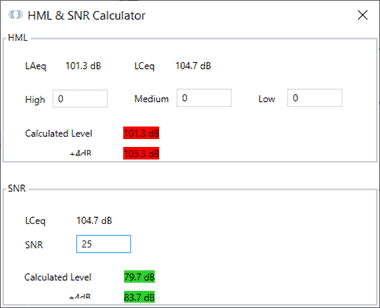
As you can see, once you have taken your measurements with the Nova, you can sync the data to the AnalyzerPlus software and use the HML & SNR Calculator.
The LCeq and LAeq are already input for you here, so all you need to do is input your SNR rating in the box below.
Once this is done, you will see the Calculated Level and the +dB correction level.
You will note the 4dB ‘real life’ factor recommendation from the HSE. This is included to take into account the imperfect fit of the hearing protection and the directional nature of noise.
2. Hearing Protection Selection with the HML Method (High, Medium, Low)
When using the HML method, you need both the measured LAeq and LCeq (not to be confused with Peak dBC) plus the H, M and L numbers taken from the Hearing Protector Technical Specification.
These represent the value for the attenuation at high, medium and low frequencies. So, if we go back to the Planer in the Woodworking Shop and the AnalyzerPlus software for the HML method, you will once again see that the LAeq and the LCeq have been automatically input:
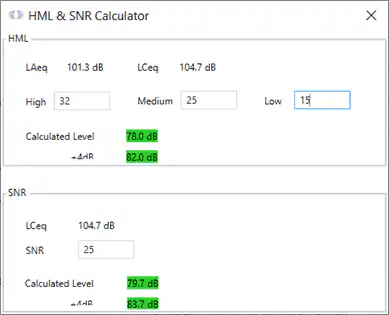
When you find your HML levels (usually found in the datasheet of your hearing protection), just input these figures into the software, and you can see if your hearing protection is a good match for you.
Quick reminder…
- The selection of adequate hearing protection is an important procedure but provided that you have the right equipment and you use it competently, then there should be no problem in recommending the appropriate hearing protection.
- It is worth remembering that hearing protection is the last resort. The priority remains to reduce the exposure to noise levels at the source below the first action level of 80dB(A) by different means.
3. Hearing Protection Selection with the Octave Band Analysis Method
For really noisy equipment with measured LAeqs consistently in the mid-90 decibels, then Octave Band Analysis is the best method to use for the selection of hearing protection. This method is meant to be the most accurate way of measuring the effectiveness of hearing protection as it looks at the actual frequencies of noise experienced by a worker.
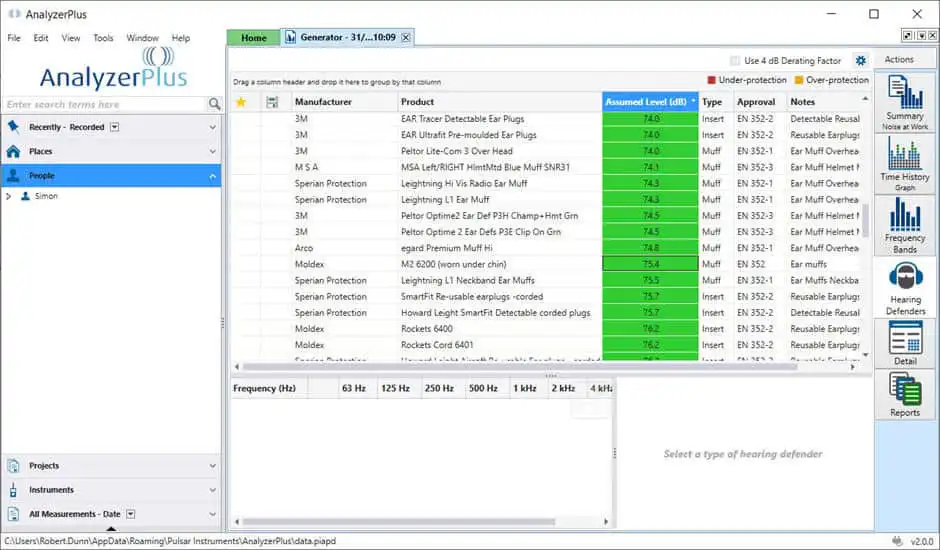
For this, you will need a sound level meter that is capable of measuring noise at octave bands centre frequency (in Hertz or Hz), such as the Nova. In this case, the software that is supplied with this type of equipment will do all the work for you. Once the noise measurements are downloaded onto the computer, the software provided will analyse the data and automatically generate lists of suitable hearing protection, such as shown below:
Using the Correct Method for Selecting Hearing Protection
So, when should you use these methods? Well, if the noise that you intend to protect against is not tonal or dominated by low frequencies, then the SNR method is fine for the selection of the appropriate hearing protection. The HML method takes some account of the frequency content of the noise, but if it is very tonal and/or has a large low-frequency content, then octave band analysis should be used for the selection of hearing protection.
Pulsar Instruments offers a range of noise measurement equipment to help you with the prescription of hearing protection using the three main methods discussed above.