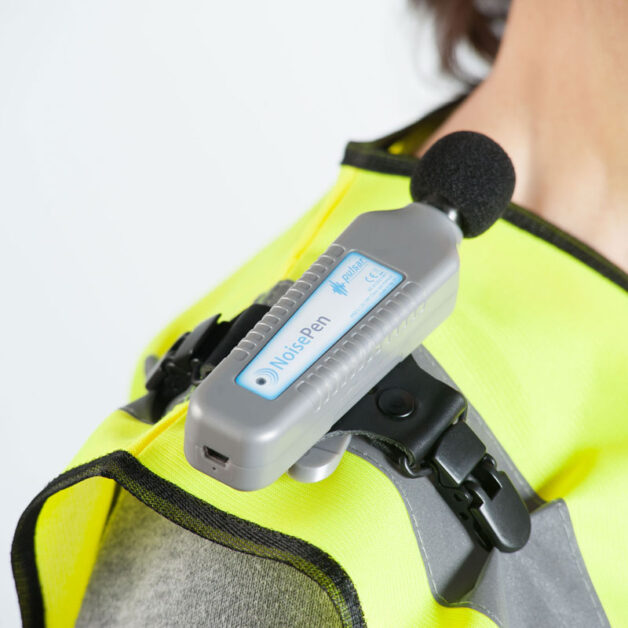

Sound level meters are sophisticated devices used to determine the sound level by capturing and measuring changes in sound pressure. They tend to be hand-held and will be pointed towards the source of noise. Put simply, sound enters the noise level meter via a small microphone. It is then processed and measurement data or values are displayed digitally in decibels to inform the user if an environment is too loud and any corrective action needs to be taken.
Imagine you are in a workplace with various machines working at the same time. Tones that have the same sound pressure level but different frequencies will not sound equally loud to the human ear. ‘A’ weighting is the internationally standardised filter applied by a sound level meter in an attempt to replicate the response of the human ear to specific frequencies. This explains why noise measurement values are expressed as dB(A).
Sound Level Meter Classes (Class 1 vs Class 2)
The Class of a noise level meter describes its accuracy as defined by the relevant international standards. Sound level meters are defined by International Standards such as IEC 61672-1:2013 (or BS EN61672-1:2003). These standards define a wide range of complex accuracy, performance and calibration criteria that instruments must meet to be fit for purpose. Within the Standard, there are two allowable levels of tolerance and these are known as Class 1 and Class 2. Class 1 is more accurate than Class 2.
A Class 1 sound level meter is often called a ‘precision’ grade meter and a Class 2 sound level meter is a ‘general grade’ meter because of their difference tolerance levels.
At lower and upper extremities of the sound frequency range* tolerances are wider, and at higher frequencies, the tolerances are narrower. At the outer extremes of the frequency range, you can expect Class 1 meters to have narrower tolerances and therefore a more accurate response.
| Performance criteria: tolerance limits at reference frequencies (for IEC61672-1:2013) | Class 1 | Class 2 |
|---|---|---|
| Frequency of 16Hz | +2.5dB, -4.5dB | +5.5dB, – ∞dB |
| Frequency of 20Hz | +/- 2.5dB | +/- 3.5dB |
| Frequency of 1kHz | +/- 1.1dB | +/- 1.4dB |
| Frequency of 10kHz | +2.6dB, -3.6dB | +5.6dB, -∞dB |
| Frequency of 16kHz | +3.5dB, -17dB | +6.0dB, -∞dB |
Class 1 sound level meters need to measure sound over a wider frequency than Class 2 meters and meet narrower tolerances for all performance criteria. Class 1 is therefore seen as being more accurate than Class 2. So we can say a Class 2 meter has wider tolerances and is therefore slightly less accurate, but for most applications, the difference is not noticeable and as Class 2 sound level meters are a lower-cost compared to Class 1, for most users a Class 2 meter still meets the standard, is accurate enough and is fit for purpose.
Which Class Sound Level Meter Do You Need?
Which meter you need will depend on what you want to use the meter for (i.e. what noise you want to measure), what measurement regulations you need to meet, and whether your measurements will be used as legal evidence (e.g. if you want your measurements submitted as legal evidence then you may prefer to use a Class 1 meter for increased accuracy). The Pulsar Nova range of noise level meters has both Class 1 and Class 2 and each offers a range of features depending on what you want to measure.
Class 1 sound level meter is often called a ‘precision’ grade meter. It is ideal for laboratory use, environmental applications, boundary noise, building acoustics, and for traffic assessments (as well as everything that a Class 2 meter can do).
Class 2 sound level meter is a ‘general grade’ meter. It is ideal for use in Noise at Work assessments, basic environmental measurements, entertainment noise, industrial hygiene, construction noise, and vehicle noise.
What Is Leq?
Leq is the equivalent continuous sound level. If noise levels are rapidly changing over time then the ‘average level’ becomes an important tool in any noise assessment, this average is called the “Equivalent Continuous Sound Level” and is abbreviated to Leq, it is measured by an integrating-averaging sound level meter that meets the international standard IEC 61672.
Knowing the Leq is vital if you are conducting noise measurements under the Noise at Work Regulations (2005); as stated above, it is the most commonly used value to describe sound levels that vary over time. More properly when we are talking about noise at work people refer to an A-weighted Leq or LAeq. Another slightly more complicated definition for Leq that is sometimes given is that a Leq is the sound level that would produce that same sound energy over a stated period of time when using a 3dB exchange rate.
Being an average level, Leq can go up and down but the longer it is measured for (time), the more stable the average gets, as it measures all the noise from the beginning of the measurement. If we were to get to this ‘stable’ value manually it would require multiple steps and many calculations to divide the sound exposure by the time over which the measurements were taken, however since the invention of more sophisticated integrating-averaging sound level meters we have these instruments to do all the hard work for us.
Why Leq Matters for Noise at Work
Regulation 5 of the Control of Noise at Work Regulations 2005 states that an employer should carry out a risk assessment and that the assessment shall include consideration of the level, type and duration of exposure, including any exposure to peak sound pressure”. Appendix 1 of the Regulations further define what should be measured :
“When making measurements to estimate the noise exposure of a person at work, you need to ascertain the equivalent continuous A-weighted sound pressure level (LAeq) that represents the noise the person is exposed to during the working day. You also need to ascertain the maximum C-weighted peak sound pressure level or levels the person is exposed to.”
As the instrument needs to measure, at a minimum, LAeq, it must, therefore, be an integrating-averaging sound level meter. It should also meet the requirements of Class 2 of IEC 61671 (BS EN 61672) – IEC 61672 the current standard for sound level meters or Type 2 of BS EN 60804:2001 (the former standard).