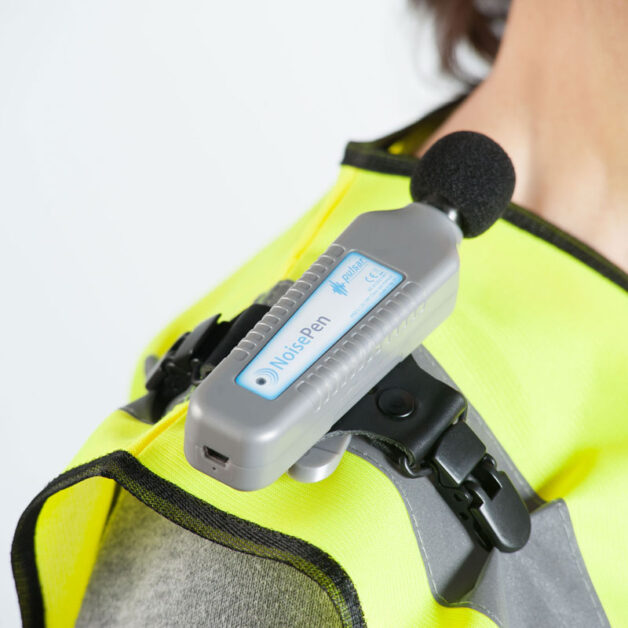
Pulsar Instruments takes a look at why you should buy professional sound level meters from an established manufacturer for your noise measurements, rather than use less accurate alternatives such as mobile sound meter apps or cheap noise meters.
Sound Meter Apps – How Accurate Are They?
There is a growing number of sound meter apps available as free downloads on Google Play Store and the Apple Store, many of these provide standard noise measurement functions, but when used with the internal microphone in your smartphone (or tablet) do not offer compliant noise measurements, and therefore have no standing legally. This is because:
- The sound level meter and its microphone must meet IEC 6172-1:2002 (Class 1 or Class 2) to be compliant with international noise measurement standards.
- For compliant measurements, the microphone and noise meter must be calibrated with an acoustic calibrator before and after your noise measurements. It is not possible to calibrate the internal microphone nor smartphone apps.
- Because of the range of smartphones available on the market, there is also the potential for significant variations in their accuracy and performance comparing model to model, thus allowing discrepancies to arise as a result. Indeed, in previous tests using the same app across a number of different devices and in a controlled industrial environment gave differences of between -28dB(A) and +10dB(A) when compared to a reference meter, this is especially true of low-frequency noise.
- In most smartphones, the internal microphone is positioned in the lower edge of the device (i.e where people talk into when making calls). Users have shown a tendency to hold the device with the microphone typically facing their body, or laid out on a table both of which affect the frequency response of the device. By the nature of the core purpose of these inbuilt microphones, they are also designed to cancel out some noise. (The location of the microphone on tablets is more variable as these are not intended to be used for calls, however, they are invariably laid flat on a table when measurements are taken not held, and also include noise-canceling).
It is possible to use a mobile with a suitable external microphone which meets the relevant instrument standards. However, the compliance officers’ measurements will still need to be made with calibrated meters, not smartphone apps (as you can’t calibrate an app).
When Can Sound Meter Apps Be Useful?
Nevertheless, some Health and Safety Officers may find that these smartphone apps can serve a purpose for carrying out quick spot checks of noise when a professional decibel meter is not available, or as range-finding devices, and may help workers make quick, educated decisions about whether they need to put their hearing protection on.
One commercial company now offers a sound level meter app in a watch. This app measures noise at the person’s wrist, not their ear though, and has similar issues with the microphones to mobile phone offerings, however, it does give you noise exposure times.
Cheap Noise Meters – Should You Use Them?
Many of the points made above about the smartphone apps apply equally when we look at the accuracy and compliance limitations of cheap noise meters.
Noise measurement instruments, and sound level meters, in particular, can vary hugely in cost as well as in complexity. It is possible to find instruments on the internet for little as £20, but these very low-cost meters can, in reality, be inaccurate to the order of 4-5dB if not more so, and with each 3dB change representing a doubling or halving of noise, it is potentially not only risky to people’s hearing but also to businesses in general if the wrong choice of meter is made.
Although there are many professionals who are using complicated and expensive sound level meters every day, for the majority of health and safety practitioners, noise is just a small part of their jobs. They understandably are looking for the cheapest and easiest meter to ‘get the job done’. There are several applications, like with the smartphone apps, that these simple meters might be adequate for, such as testing fire alarm noise levels and simple office or machinery noise level checks. However, many of these meters are not legally compliant with international noise measurement standards. This means that they cannot be used to measure occupational noise in compliance situations for example in workplace noise assessments (under the Noise at Work Regulations 2005).
For these users, Pulsar Instruments believes there is a strong case to be made for choosing an instrument that meets both the requirements of any regulations, standards or guidelines whilst keeping its practical operation as simple as possible.
What Does the Law Require for Workplace Noise Measurements?
The minimum requirements for a compliant noise at work sound meter are that it is an integrating averaging meter compliant with IEC 61672-1:2002 and that it measures:
- The equivalent continuous A-weighted sound pressure level (LAeq)
- The maximum C-weighted peak sound pressure level (LCPeak)
If there is a need to prescribe suitable hearing protection it should ideally also:
- Measure equivalent continuous C-weighted sound pressure level (LCeq); or
- The Leq in octave frequency bands.
Are Sound Meter Apps and Cheap Meters Worth the Risk?
So, should sound meter apps and cheap noise meters be used where there is a requirement to be compliant with a standard or regulation?
All meters manufactured by Pulsar Instruments comply with IEC 61672-1 and IEC 61672-2 (the international standards for Electroacoustics – Sound level meters) and are then periodically verified meet to IEC 61672-3, and offer a higher degree of accuracy (accuracy better than 1.5 dB). These are the standards, regulations and guidelines to which most Health and Safety Officers and Environmental Officers are working to around the world.
Even the app developed by the National Institute for Occupational Safety and Health (NIOSH) in the USA contains a disclaimer that “…we want to emphasize that smartphones and smartphone sound apps were not designed to meet such rigorous standards and that this app does not meet Type 2/Class 2 standards and should not be used for compliance purposes”.
Pulsar is not here to approve or disapprove of the use of these sound meter apps or cheap noise meters. Apps can play a role when used with the appropriate microphone, and likewise, there are many applications where they and very basic noise meters can be an effective way to take quick indicative measurements. But in our opinion users who rely on them for critical ‘legal’ measurements are putting their businesses at risk of hearing loss claims and regulatory fines as well as potentially risking noise-induced hearing loss (NIHL) in their employees, and therefore it is a false economy to use this type of instrument for any meaningful measurements.
For 50 years, Pulsar has been helping companies around the world meet their legal requirements for safeguarding their employees’ hearing with our wide range of affordable, robust, accurate and easy-to-use sound level meters. Contact us to find out more.